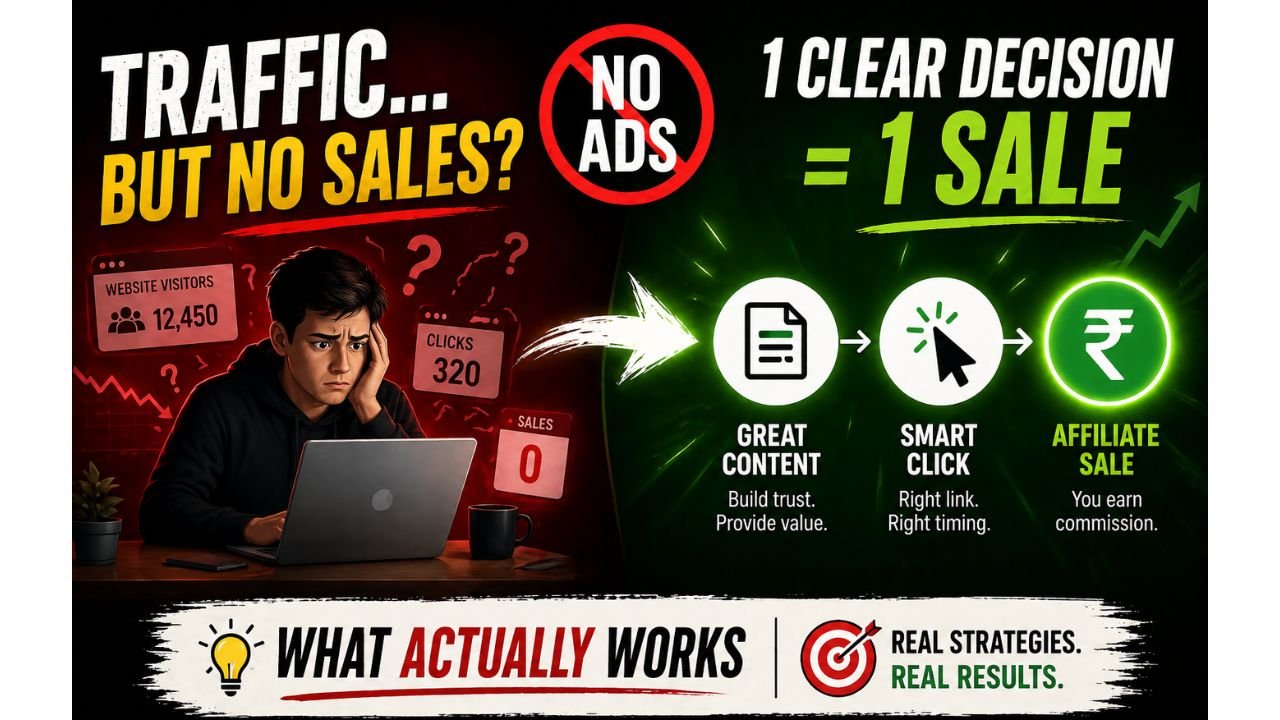
Getting your first affiliate sale without ads sounds straightforward when you think about it. Create content, add links, and wait for results. But once you actually try it, it doesn’t move the way you expect.
You keep posting.
You see some clicks.
Sometimes even traffic shows up.
But the sale never happens.
That’s where it becomes confusing — because nothing looks completely wrong, yet nothing is working either. The real issue is not effort or consistency. It’s understanding what actually needs to happen between someone seeing your content and deciding to act.
- If people are clicking… why aren’t they buying?
- Is something missing… or am I focusing on the wrong things?
- At what point does a visitor actually turn into a sale?
This post is not about getting more traffic or adding more links — it’s about understanding why your first affiliate sale hasn’t happened yet, and what actually changes that.
Without Ads – What Does It Actually Mean?
“Without ads” simply means you’re not paying to bring people — no paid traffic, no pushing links, no shortcuts. Instead, the sale comes from content, where someone finds your page naturally and decides based on what they see.
What starts creating confusion:
With ads → you bring people…
without ads → people choose to come
With traffic → you get visibility… without the right intent → nothing happens
Are clicks enough… or does something need to happen after the click?
If you’re not using ads… then what actually makes someone go from seeing your content to buying?
Organic Traffic – Where It Comes From ?
Organic traffic is not just people visiting your content. It’s people arriving with a reason — usually through search, where they’re already looking for something specific.
But not all organic traffic behaves the same.
- Some people come to understand.
- Some come to explore.
- Very few come ready to decide.
That’s why traffic alone doesn’t create results — because the outcome depends on why they arrived, not just that they arrived.
Where things start getting unclear :
- If traffic is coming… why is nothing converting?
- Are all visitors equal… or does intent change everything?
- Does ranking on Google mean people are ready to buy?
If organic traffic is already coming… then what actually separates visitors from buyers?
Sometimes it starts making more sense when you look at why some websites actually generate income while others don’t, even when both are putting in similar effort.
From Traffic to Money ?
When traffic starts coming to your page, it creates a feeling that things should start working. You see visitors, maybe even clicks, and naturally the expectation builds that a sale should follow. But in most cases, nothing changes. The reason is simple — traffic only means people arrived, not that they are ready to act. What actually matters is whether your content moves them from thinking to deciding.
Where things usually break:
- The user comes with a specific doubt, but the content stays general
- Too many options are shown instead of guiding toward one direction
- The page explains well, but doesn’t lead to a decision
- The user understands more… but still feels unsure
What starts working is not adding more information, but removing confusion.
Instead of trying to cover everything, the content needs to match the exact situation the user is in. When someone is already thinking “should I go for this or not,” your page should not expand the discussion — it should narrow it down.
That’s the shift.
- Are you helping the user decide… or just helping them think more?
- Does your content move them forward… or keep them in comparison mode?
- At what point does your page make the choice easier?
If people are visiting but not converting… what exactly are they missing on your page?
Why Visitors Don’t Turn Into Income
When people start getting traffic, the expectation quietly shifts — “now it should convert.” But when it doesn’t, it creates a different kind of confusion. Because the problem is no longer about getting people, it’s about understanding why those people are not taking any action.
The truth is, most visitors are not refusing to buy — they’re just not reaching a point where buying makes sense to them. That gap is not always visible, but it’s exactly where conversions stop.
- The user understands the content, but doesn’t feel confident enough to act
- The page explains features, but doesn’t connect to the user’s situation
- The recommendation feels like a suggestion, not a clear direction
- The user leaves with information… but without a decision
When that clarity is missing, users don’t reject the product — they postpone the decision. And postponed decisions rarely come back.
- Are people leaving because they don’t like the product… or because they’re still unsure?
- Does your page guide a decision… or leave everything open?
- What exactly stops the user from saying yes?
Are you showing information… or building confidence?
The platform you choose also changes how people interact with your content, and that difference becomes more visible when you compare how websites and social media actually perform over time.
Where It Actually Fails (Real Situations)
Sometimes the problem is not big or complicated. It’s in small things that look normal but quietly break the whole flow. From outside, everything feels fine — content is there, links are placed, traffic is coming. But when you look closely, the user is not getting what they actually came for.
That’s why it becomes hard to figure out what’s wrong. Because nothing looks obviously broken.
And when you look deeper into how content performs in search, it becomes obvious that matching what people are actually looking for matters more than just creating more content.
What it looks like in real situations
Situation 1:
User searches → “Is this product worth buying?”
Your page shows → features, specs, general info
👉 Problem:
User wanted a decision… got information
👉 What works instead:
Clear answer + why it fits (or doesn’t)
Situation 2:
User searches → “best option under budget”
Your page shows → 10 products list
👉 Problem:
Too many choices → more confusion
👉 What works instead:
2–3 strong options + clear comparison
Situation 3:
User reads full content → understands everything
Still leaves
👉 Problem:
No clear next step
👉 What works instead:
One direct suggestion + why now
Situation 4:
Content is helpful… but feels general
👉 Problem:
User doesn’t feel “this is for me”
👉 What works instead:
Specific use-case + relatable situation
What becomes clear from this is —
it’s not about writing more or adding more products.
It’s about matching the exact point where the user is stuck and resolving that one thing properly.
When that happens, the page stops feeling like content… and starts feeling like a decision point.
- Are you answering what the user asked… or what you want to explain?
- Does your page reduce choices… or increase them?
- At the end of your content, is the next step obvious?
Are you helping them decide… or just helping them think more?
What You Should Do ?
After seeing all those situations, the confusion usually becomes this:
“Okay… I understand what’s going wrong… but what exactly should I change?”
Because the problem is not lack of effort.
It’s direction.
What to STOP doing
Most of this feels normal when you’re doing it, but this is exactly where things break:
- Trying to cover everything in one page
- Listing too many options without helping choose
- Explaining features instead of answering decisions
- Adding affiliate links before the user is ready
- Writing content for “everyone” instead of one clear situation
These don’t look wrong… but they keep the user in thinking mode.
What to START doing
Instead of changing everything, the shift is simple — but specific.
Start with one clear situation.
Not a broad topic…
👉 one exact moment where the user is stuck.
Then build your content around that.
- Answer the exact question they came with
- Reduce options instead of expanding them
- Give one clear direction (not multiple possibilities)
- Place your link only after the decision feels natural
- Write like you’re helping one person decide, not informing everyone
What changes here is not the content length or quality.
It’s the clarity of outcome.
The user should not leave your page with more ideas.
They should leave with a decision.
How to think while creating content
Instead of asking:
👉 “Is this content good?”
Start asking:
👉 “Does this help someone decide something right now?”
That single shift changes everything.
👉 If someone reads your page completely… what decision are they able to make?
Your first affiliate sale doesn’t come from doing more.
It comes from doing one thing clearly enough that the user doesn’t feel the need to keep searching.
Another part that often gets ignored is the niche itself, because the type of audience you attract can directly affect whether people just read or actually take action.
How First Affiliate Sale Without Ads Actually Happens
At this point, the problem is no longer about traffic or understanding. It’s about how you place your content and links in a way that actually leads to action.
Because even when everything is clear, many pages still don’t convert — not because the idea is wrong, but because the way products are shown doesn’t match how people decide.
Where most pages lose the conversion
- Links appear too early, before the user is ready
- Products are listed, but not positioned clearly
- The recommendation feels optional, not necessary
- The page ends without a clear direction
So even after reading everything, the user leaves thinking:
“Okay… I’ll check later”
And that “later” rarely comes back.
What actually works inside a blog or review page
The shift is not about adding more links — it’s about placing them at the right moment.
👉 When the user is still exploring
→ don’t push a product
👉 When the user is comparing
→ reduce options and guide
👉 When the user is deciding
→ give one clear recommendation
Turning Traffic Into Affiliate Income Without Ads
Instead of:
Intro → random info → product links
Make it:
Problem → clarity → narrowed choices → final recommendation → link
How to show products properly:
- Don’t list too many — it creates hesitation
- Show why one option fits a specific situation
- Use simple reasoning, not technical overload
- Make the recommendation feel natural, not forced
Where to place affiliate links:
- After the user understands the context
- After you reduce their confusion
- At the exact point where they feel ready
Not before that.
What you should NOT do:
- Drop links in the beginning
- Add multiple “Buy Now” without context
- Recommend everything without clarity
- Assume the user will decide on their own
What you SHOULD do:
- Guide toward one clear outcome
- Place links only after decision is formed
- Write like you’re helping someone choose
- Keep the flow natural from doubt → clarity → action
What this does is simple.
The page stops feeling like content…
and starts behaving like a decision path.
Without ads doesn’t mean slow or random.
It means:
👉 You’re not forcing people to act
👉 You’re building a point where acting feels natural
Your first affiliate income without ads comes from one thing — placing the right recommendation at the moment the user is ready to act.
How an Affiliate Website Actually Looks
If you’re trying to understand how this works in real, just look at a simple affiliate website.
It’s not complicated.
You’ll see:
- one product or one topic
- clear explanation
- a few options (not too many)
- and a simple recommendation
That’s it.
Instead of trying to explain everything, the page focuses on helping you decide something.
That’s how a site like BadriDeals is built.
You go there, see a product, understand it quickly, and know what to do next.
You can check it here👉 badrideals.com
Without Ads vs With Ads
Before getting into results, this is where most people misunderstand how things actually work.
| 🚀 With Ads | 🌱 Without Ads |
| 💸 Paid traffic | 🔍 Organic traffic |
| ⚡ Fast reach | 🐢 Slow build |
| 💰 Needs money | ⏳ Needs time |
| 🎯 Mixed intent | ✅ Clear intent |
| 📢 Push offers | 🤝 User decides |
| ⛔ Stops fast | 📈 Grows steady |
| 💵 Budget needed | 🧠 Clarity needed |
At the same time, the way websites generate income through ads becomes clearer when you understand how engagement and user behavior play a role in it.
FAQ
My content is helpful, but still no income. Why?
Helpful content alone is not enough. It also needs to guide the user toward a clear outcome. If the content informs but doesn’t lead to a decision, it won’t convert.
Can I really get my first affiliate sale without ads?
Yes, but it works differently. Without ads, the sale comes from content that matches user intent. It may take time, but once it connects properly, it becomes more consistent.
Do I need a lot of traffic to get my first affiliate sale?
Not really. Even a small amount of traffic can convert if it comes with clear intent. One person who is ready to decide is more valuable than many who are just browsing.
I’m getting some traffic… but still no sales. Is this normal?
Yes, this happens a lot in the beginning. Traffic only means people are visiting, not that they are ready to buy. Most visitors are still figuring things out, so if your content doesn’t help them reach a decision, they will leave without taking action.
I added affiliate links, but nobody clicks. What am I doing wrong?
Usually, links are placed too early or without enough context. If the user hasn’t understood why the product matters to them, they won’t click. The link works only when the content has already reduced their doubt.
Am I missing something, or does it just take time?
Both can be true. Time is required, but direction matters more. If the content is not aligned with user intent, more time alone won’t fix it.
My Understanding
At one point, I thought the problem was not getting enough people.
It felt like if more traffic comes, something will eventually work. But even when a few people started coming, nothing really changed. That’s when it started feeling confusing — because the issue was not visible anymore.
Then I noticed something small.
People were not leaving because the content was bad. They were leaving because they didn’t reach a point where they could decide anything. They read, understood, and still felt like they needed to look somewhere else.
That’s where it actually breaks.
What changed for me was not doing more.
It was looking at what happens after someone lands.
Instead of thinking:
“Did they visit?”
It became:
“Did this help them move forward?”
And slowly it became clear —
It’s not about bringing people in.
It’s about what happens when they are already there.
What I started focusing on:
- One clear situation instead of broad topics
- Fewer options instead of more choices
- Making things easier to decide, not just understand
Now it doesn’t feel random anymore.
It feels like there’s a point where things either connect… or don’t.
And once that connection happens, even a small amount of traffic starts to matter.
⛳ When your page makes the choice clear, clicks turn into decisions.
🎯 When confusion ends, conversion begins.