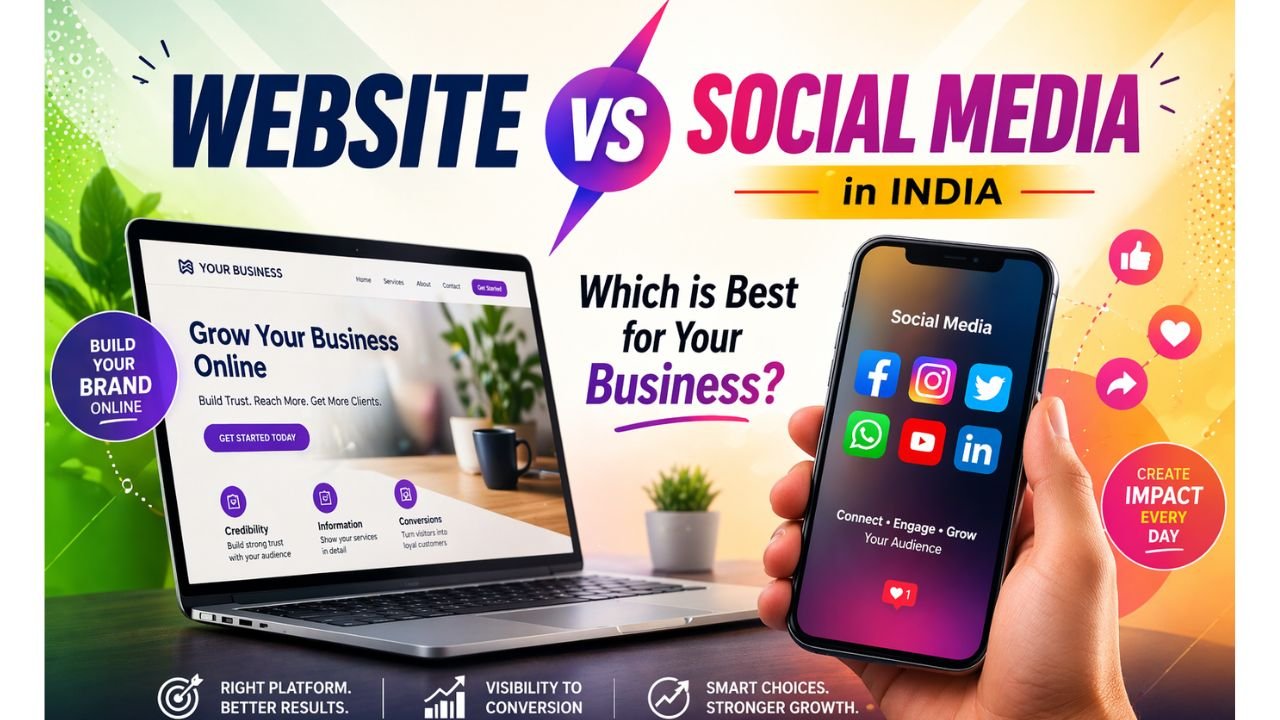
Most people searching for website vs social media in India are not just comparing platforms — they are trying to understand what will actually work for their business. Social media looks easy and fast, while a website feels like a long-term investment. Because of this, many people choose based on convenience instead of strategy. But when the goal is business growth, visibility alone is not enough. The real difference comes from understanding how each platform works, where it fits, and how it contributes to results.
🔍 Explore This Guide
The Common Trap
Everyone starts with the same thought:
👉 “Let me grow on social media first… website later.”
It feels logical. It feels easy. It feels practical.
But this is exactly where most people delay real growth —
because they build visibility first, without building a system to convert it.
The Illusion of Growth
More followers.
More likes.
More views.
Everything looks like growth.
But ask one simple question:
👉 “Is this turning into actual business?”
If the answer is no, then it’s not growth — it’s just activity.
But when the goal is not just to be visible, but to actually grow a business, this confusion becomes critical. Because both platforms serve completely different purposes, and misunderstanding this difference is the reason why many businesses stay active online but fail to get real results.
This is not about which platform is popular. It is about what actually works when your goal is business growth.
Everyone is Building Something… But Few Are Getting Results
Most businesses today are active online. Some are posting daily on Instagram, others are investing in websites. But despite all this activity, results are not equal. Some get clients consistently, while others struggle even after months of effort.
👉 The difference is not effort.
👉 The difference is understanding where each platform actually works.
This creates confusion because activity is often mistaken for progress. Just because something is visible does not mean it is effective. A large number of people are active online, but only a small percentage are actually converting that activity into business growth.
The gap lies in understanding how each platform contributes to the overall system.
Instead of building everything on one platform,
👉 Start thinking in layers:
Where do people discover you?
Where do they trust you?
Where do they take action?
When you answer this, the confusion disappears.
Which One Should You Focus On First?
This is one of the most searched and most misunderstood questions. Most beginners naturally choose social media because it feels accessible. There is no setup cost, no technical barrier, and results appear quickly.
However, choosing based on ease rather than purpose leads to long-term limitations. Social media is excellent for starting visibility, but it is not designed to handle deeper user decisions. A website, although slower to set up, creates a structured environment where users can explore, understand, and take action.
But the real question is not “which is easier” —
👉 it is “which one aligns with your goal.”
Understanding the Core Difference Between Website and Social Media
At a fundamental level, a website and social media platform operate on completely different principles.
A website is a controlled system where you define the structure, content flow, and user journey. It is designed to provide clarity and guide users toward a specific action. Social media, on the other hand, is built around attention. It prioritizes engagement, speed, and continuous consumption.
This difference changes everything in how users behave on each platform.
Key differences:
- Website = structured system
- Social media = attention platform
- Website = long-term asset
- Social media = short-term visibility
When you understand this, the confusion between the two starts to disappear.
Website vs Social Media in India: A Practical Comparison
| Factor | Website | Social Media |
| Ownership | Fully yours | Platform controlled |
| Visibility | SEO-based (search driven) | Algorithm-based (feed driven) |
| Control | Complete control | Limited control |
| Conversion | High (structured) | Low to moderate |
| Longevity | Long-term value | Short content lifespan |
This comparison is not about declaring a winner. It highlights that both operate in different layers of the same system.
What If You’re Building on the Wrong Platform?
Imagine spending months creating content on social media, gaining followers, and building engagement — but not receiving serious enquiries. Or investing time and money into a website that no one visits because there is no traffic source.
Both scenarios are common, and both lead to frustration. The problem is not effort; it is direction.
When effort is applied on the wrong layer of the system, results don’t align with expectations.
Social media is rented space.
A website is owned space.
👉 One can change anytime.
👉 The other stays under your control.
Why Social Media Feels Powerful (But Has Hidden Limits)
Social media gives immediate feedback, and that feedback creates a sense of progress. When a post performs well, it feels like growth is happening. This is why many people invest heavily in content creation.
However, the limitations become visible over time. Reach is not consistent, algorithms change frequently, and content has a very short lifespan. What works today may not work tomorrow.
More importantly, social media is not structured for conversion. Users scroll quickly, consume content passively, and rarely make decisions in that environment.
Where social media works best:
- Initial visibility
- Brand awareness
- Audience discovery
Where it struggles:
- Building structured trust
- Handling complex decisions
- Creating consistent lead flow
Why a Website Alone Also Fails in Most Cases
On the other side, many people build a website and expect results automatically. This expectation leads to disappointment.
A website without traffic is like a store without visitors. It may be well designed and structured, but if people are not reaching it, nothing happens.
Websites require input — through SEO, social media, or other channels. Without that input, even a strong website remains underutilized.
This is why choosing only one platform rarely works effectively.
Can Social Media Replace a Website Completely?
This is one of the biggest misconceptions.
The answer is no — because both serve different roles.
Social media can help you connect with people, but it does not provide a structured environment where users can fully understand your offering. There is limited space to explain, organize, and guide decisions.
A website fills that gap by acting as a central hub where users can move from interest to action.
👉 People scroll on social media
👉 People decide on websites
Differences in Real Business Scenario
This is the most important section of this entire discussion.
The real answer is not choosing between the two. The real answer is understanding how they work together.
A business grows when attention is converted into action. Social media is effective in generating attention. A website is effective in converting that attention into enquiries or leads.
When used together:
Social media attracts users
Website builds trust
Website drives conversion
This combination creates a complete system instead of isolated efforts.
It’s not about choosing between website and social media.
It’s about understanding where each one fits in your growth system.
Reality Check: Activity vs Results
At this stage, it becomes important to separate activity from effectiveness.
- Posting daily does not guarantee business growth
- Having a website does not guarantee enquiries
- Being active online does not guarantee results
What matters is how well each element is connected into a system.
Many people stay busy, but very few build systems that produce consistent outcomes.
If you expect social media to bring consistent clients, you will struggle.
If you expect a website to generate traffic without effort, you will also struggle.
👉 Both fail when used incorrectly.
The Wrong Starting Point
Most people don’t fail because they chose the wrong platform.
They fail because they start without understanding what they actually need.
Some start posting daily on Instagram.
Some rush into building a website.
Both feel like progress.
But here’s the problem —
👉 They are building tools before defining purpose.
And when purpose is missing, even the best platform becomes ineffective.
You Are Not Choosing a Platform — You Are Choosing a Path
This is where the entire perspective changes.
When you choose social media, you are choosing speed, reach, and constant activity.
When you choose a website, you are choosing structure, depth, and long-term positioning.
Neither is wrong.
But choosing one without understanding its path creates imbalance.
👉 Social media path = fast start, unstable results
👉 Website path = slow start, stable results
The real question is:
👉 Which path matches your business stage?
The Visibility Trap: Why Being Seen Is Not Enough
This is where most people get stuck.
Social media makes you visible.
People see your content, interact, and even remember you.
But visibility creates an illusion.
Because being seen does not automatically mean being trusted.
And without trust, users don’t take action.
👉 Visibility attracts attention
👉 Trust drives decisions
Most people build the first — very few build the second.
The Control Illusion
People think they are growing on social media.
But they are growing within limits they don’t control.
Reach depends on algorithms.
Visibility depends on platform rules.
Growth depends on consistency that may not always sustain.
This creates a hidden risk.
👉 You are building on something you don’t own.
A website removes this dependency.
It may grow slower — but it grows on your terms.
Why Most Comparisons Fail (And Mislead You)
Most articles compare features:
- Website vs Instagram
- Website vs Facebook
They list pros and cons.
But they miss the real point.
Because this is not a feature comparison —
👉 it’s a role comparison.
Comparing them directly is like comparing:
- A showroom
- And a marketplace
Both are useful. But for different stages.
Which One Builds a Stronger Business Foundation?
At a surface level, both website and social media look like tools to grow online. But when you look deeper, they contribute to business growth in completely different ways. One builds visibility, while the other builds stability. One depends on continuous activity, while the other strengthens over time.
The real question is not which one is more popular —
👉 it is which one creates a stronger foundation for long-term business growth.
Website vs Social Media in India for Long-Term Growth
When businesses think long-term, the focus shifts from quick results to sustainable outcomes. This is where the difference between website and social media becomes more visible.
A website grows as an asset. Over time, it accumulates content, improves SEO performance, and builds authority. Each improvement adds value that stays with the business. Social media, on the other hand, requires continuous effort to maintain visibility. The moment activity slows down, reach often drops.
Key differences in long-term growth:
- A website compounds over time through SEO and structured content
- Social media resets frequently based on algorithm changes
- Website traffic can grow consistently with the right strategy
- Social media visibility depends on ongoing content output
This doesn’t make social media weak — it makes it different. It works best as a driver of attention, not as a long-term foundation.
Which One Supports Business Stability Better?
Stability in business comes from predictability and control.
A website allows you to build systems — structured pages, clear messaging, and defined user journeys. This creates a predictable flow where users can understand your offering and take action.
Social media, while powerful for reach, is less predictable. Engagement can fluctuate, visibility can change, and dependency on the platform remains high.
👉 This is why businesses that rely only on social media often feel unstable, while those with a strong website foundation experience more consistency.
Which One Actually Converts Visitors into Clients?
At some point, every business reaches this stage — visibility is there, people are watching, content is being posted… but results are still inconsistent. This is where the real difference between website and social media becomes clear.
Because attracting people is one part of the process. Converting them into clients is a completely different layer.
Website vs Social Media in India for Lead Generation
Lead generation is not just about getting attention — it is about capturing intent.
On social media, intent is often weak. People may like your content, follow your page, or even send occasional messages, but this does not create a predictable flow of enquiries. There is no structured path guiding users from interest to action.
A website introduces that structure.
It allows you to:
- Present your offering clearly
- Answer common questions
- Build trust through content and layout
- Direct users toward enquiry or contact
This structured approach makes lead generation more consistent.
Why Social Media Engagement Doesn’t Always Turn into Clients
Engagement feels valuable, but it does not always translate into business outcomes.
A post may receive high reach, strong interaction, and positive responses. But when it comes to actual conversions, the results often fall short. This happens because engagement measures interest, not intent.
There is a gap between:
- “This looks good”
and - “I want to take action”
That gap is rarely closed on social media alone.
A website helps bridge this gap by:
- Reducing distractions
- Providing clarity
- Guiding users step-by-step
The Conversion Flow Most Businesses Miss
A simple shift can change results completely.
Instead of expecting social media to convert users directly, businesses should use it as an entry point. Once interest is created, users should be guided to a platform where decisions can happen.
👉 Ideal flow:
- Social media → attracts attention
- Website → builds understanding
- Website → converts into enquiry
When this flow is missing, effort gets scattered. When this flow is structured, results become predictable.
FAQ
Is social media enough for local businesses in India?
For very small or local businesses, social media can bring initial enquiries, especially through WhatsApp or direct messages. But as the business grows, depending only on social media can create limitations. A website helps organize your services, improve credibility, and attract more serious customers.
What kind of businesses benefit more from a website?
Businesses that involve higher value services, detailed explanation, or trust-based decisions benefit more from having a website. For example, services like consulting, digital marketing, or professional services need more clarity, which is difficult to provide only through social media.
How should I use website and social media together?
The most effective approach is to connect both into a simple system. Use social media to attract attention and reach new people. Then guide those users to your website, where they can learn more and take action. This creates a complete flow from visibility to conversion, instead of relying on one platform alone.
Can social media replace a website completely?
No, because both platforms operate differently. Social media is designed for engagement and discovery, while a website is designed for clarity and conversion. Without a website, it becomes difficult to present detailed information and guide users toward action. Social media can support a business, but it cannot fully replace a website.
Is a website useful without social media or traffic?
A website alone is not enough if no one visits it. It needs traffic from sources like SEO, social media, or referrals. Without traffic, even a well-designed website will not generate results. The best approach is to use social media or other channels to bring visitors, and then use your website to convert them.
Which platform is better for long-term business growth?
A website is stronger for long-term growth because it builds an asset over time. With proper SEO and structured content, it can generate consistent traffic and leads. Social media, on the other hand, requires continuous effort to maintain visibility. While both are useful, a website provides more stability in the long run.
🚀 What Should You Do Next?
If you’re serious about building results (not just reading), follow this path:
Conclusion: Website vs Social Media in India
Website vs social media in India is not about choosing one. Both play different roles in business growth.
The practical reality is simple. Businesses that rely only on social media often struggle with consistency, while those that depend only on a website struggle with visibility. Growth happens when both are connected into a clear system where attention flows into structured conversion. This is not a theory, but a pattern visible across businesses that generate consistent results online.
Social media helps people discover you.
A website helps them understand and trust you.
If you depend only on social media, results stay inconsistent.
If you depend only on a website, visibility becomes a problem.
👉 Real growth happens when both work together.
Social media brings attention.
Website converts that attention into results.
That’s the difference between being active online and actually growing a business.
My Understanding (What I Realized)
After trying both sides, I noticed something simple — social media keeps you busy, but it doesn’t always move things forward. It gives visibility, but not always clarity. Over time, it started feeling like I was putting effort into something that resets every day, instead of building something that stays.
That’s when I started looking at websites differently — not as an extra step, but as a base where everything actually connects and makes sense.
- I was putting effort regularly, but it felt like I was starting fresh every time
- Even when something worked, it didn’t carry forward — it just ended there
- There was no sense of continuity, just repetition
At first, social media felt like the main thing. It was easy to start, things moved quickly, and it looked like progress. But after some time, it started feeling like everything depends on what I do today. If I stop, it slows down. Nothing really stays.
Website felt different.
It didn’t give that instant feeling, but it felt more stable. Whatever I put there stays, builds, and connects over time. It didn’t feel fast, but it felt like something I can rely on.
- I began to think about what happens after someone sees my content
- It didn’t feel enough to just post — there had to be somewhere it leads
- Relying on one platform didn’t feel stable after a point
- Things made more sense when everything had a direction
So for me, it’s not really about choosing one.
Social media feels like something that keeps things moving.
Website feels like something that actually holds things together.
That’s just how it started making sense to me.
⭐ That’s when I understood — one keeps things moving, the other actually builds something.
🤝 Need Help Choosing the Right Approach?
If you’re still confused between website and social media, don’t worry. Tell me your business type — I’ll suggest what actually works for you.
💬 Chat on WhatsApp