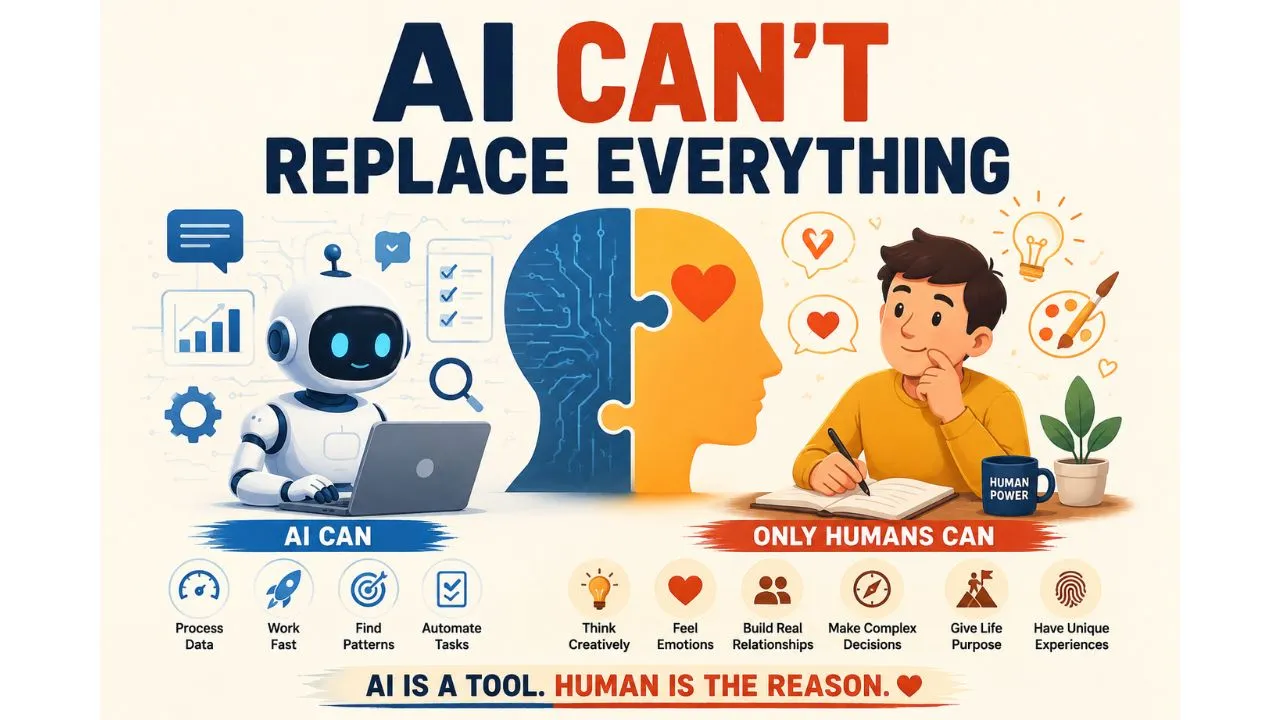
AI tools are becoming part of everyday work, and many people now wonder how much they can actually replace humans. They can write, design, generate ideas, and make work faster — but some things still feel deeply human. That’s why more people are starting to understand that AI can’t replace everything, especially when it comes to emotions, real experiences, creativity, and human thinking.
AI can do many things faster… but can it truly think and understand like humans?
The Biggest Limitation of Artificial Intelligence
AI can answer questions fast.
It can write emails, generate images, and even talk like a real person.
But there’s one thing it still cannot truly understand:
Human emotions.
AI can recognize words like sad, happy, or stress.
But it doesn’t actually feel them.
For example, if someone is going through a difficult phase in life, AI may give helpful advice.
But a real friend understands the silence, emotions, and pain behind those words.
That’s the difference.
The same thing happens in customer support.
People may use AI chatbots for quick answers.
But when frustration or emotions are involved, most people still want to talk to a real human.
Because empathy cannot be automated completely.
AI works with data.
Humans work with experiences.
And that human connection is still something artificial intelligence cannot fully replace.
AI needs direction first
Most people think AI works like a human brain —
but it doesn’t.
AI doesn’t wake up with ideas, opinions, or goals.
It waits for instructions first.
Without prompts, AI does nothing
- No thinking on its own
- No personal intention
- No real-world awareness
- No self decisions
AI works based on input
The better the instruction → the better the output.
Bad prompt → weak result
Clear prompt → useful result
Real example
If you ask AI:
- “Write something” → generic output
- “Write a simple intro for beginners” → better result
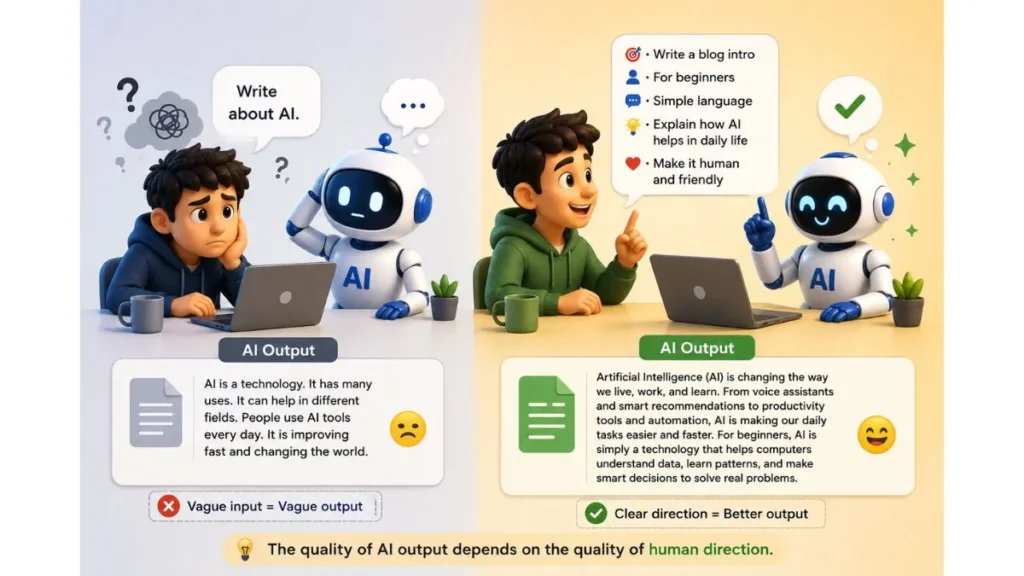
AI depends on direction.
Humans decide the direction.
👉 AI can generate answers
👉 Humans decide what actually matters
AI still waits for humans
Many people now use AI daily, so it starts feeling like AI can think and work completely on its own. But in reality, AI still depends heavily on human direction.
AI doesn’t randomly decide to create something important. It waits for input first. The quality of the result depends on what humans ask, explain, or guide.
For example, if someone types:
“Write a blog intro”
AI may generate something very generic.
But if the instruction becomes:
“Write a simple, human-style intro for beginners confused about AI replacing humans”
the result becomes much more useful.
The difference is not the AI itself — it’s the human thinking behind the instruction.
The same thing happens with image generation.
If someone simply says:
“Create an image”
AI has no clear understanding of style, purpose, or emotion.
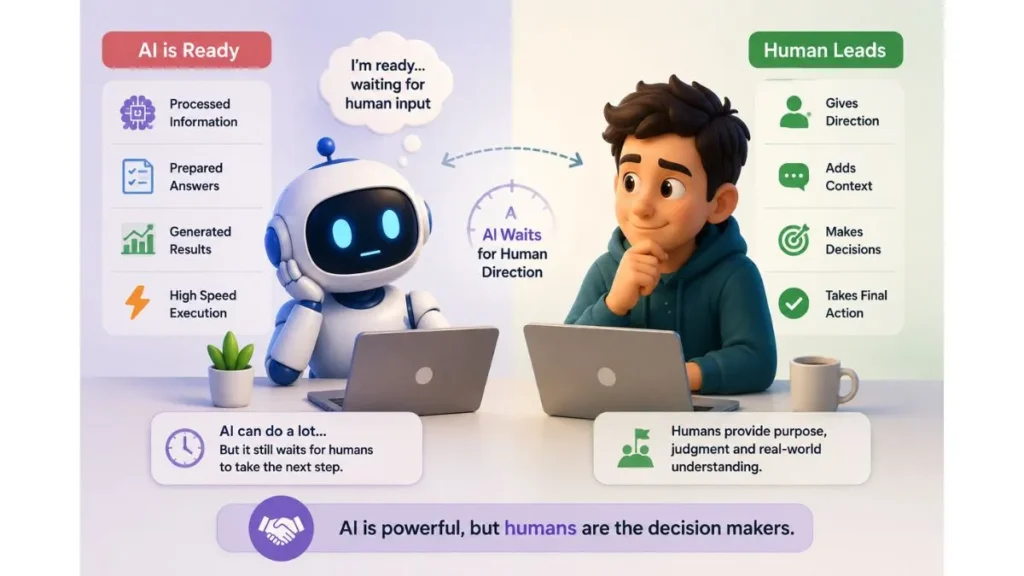
But when a person explains:
- the mood
- the audience
- the feeling
- the message
the output changes completely.
This is why AI still feels more like a powerful assistant than a true independent thinker.
It can process information quickly, but it still needs humans to decide:
- what matters
- what feels right
- what should actually be created
AI mistakes still feel different
AI can generate logos, captions, blog content, or designs in seconds. But many times, the result still feels too similar, too safe, or missing personality. It may look correct, but not memorable.
A human can notice when something feels wrong, emotional, or uncomfortable — even without someone directly saying it.
For example:
- a friend saying “I’m fine” while clearly upset
- a conversation suddenly becoming awkward
- someone needing support without asking for it
Humans understand these situations naturally because they come from real experiences and emotions.
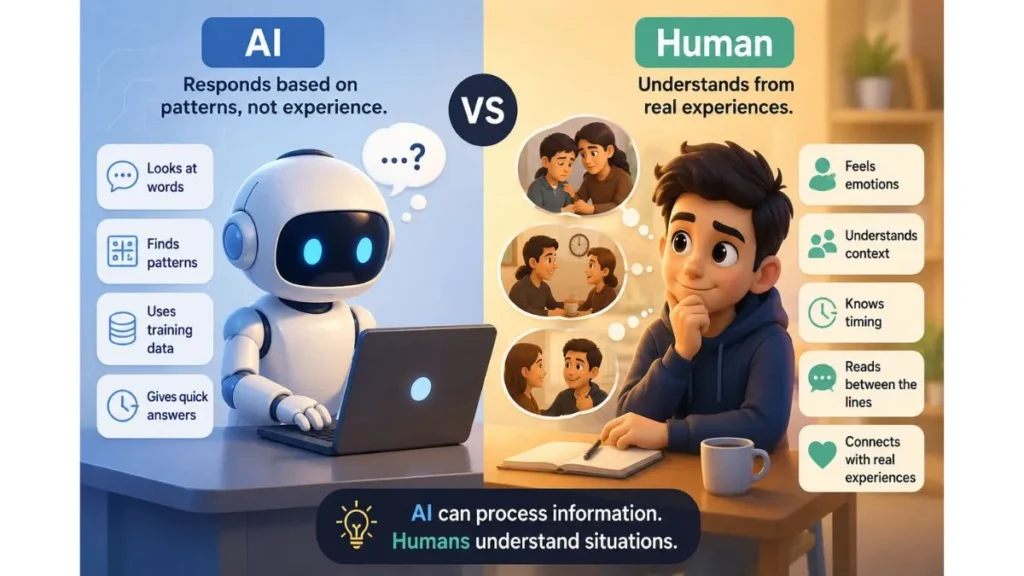
AI usually responds based on patterns and words, not real human experiences. That’s why sometimes AI answers may sound correct… but still feel emotionally empty or disconnected.
That’s why people still edit AI content before posting it.
Not because AI is useless —
but because humans still notice what feels real and what doesn’t.
The human skills AI cannot copy
One interesting thing is happening now.
As AI tools become more common, people are also becoming better at noticing what feels “too AI-generated.”
At first, AI content feels impressive because it is fast, clean, and structured. But after seeing enough of it, many people start feeling that something is missing.
The words may look correct.
The design may look polished.
The answer may sound smart.
But sometimes it still feels:
- too predictable
- too safe
- too similar
- missing real personality
For example, imagine two people applying for a job.
One person submits a perfectly AI-written message.
Everything looks correct.
Another person writes naturally, shares a real experience, explains a genuine struggle, and speaks in their own way.
Most people instantly feel the difference.
Not because one is grammatically better —
but because one feels human.
The same thing happens in business, content creation, communication, and creativity. People naturally connect more with originality than perfect automation.
That’s why human perspective still matters.
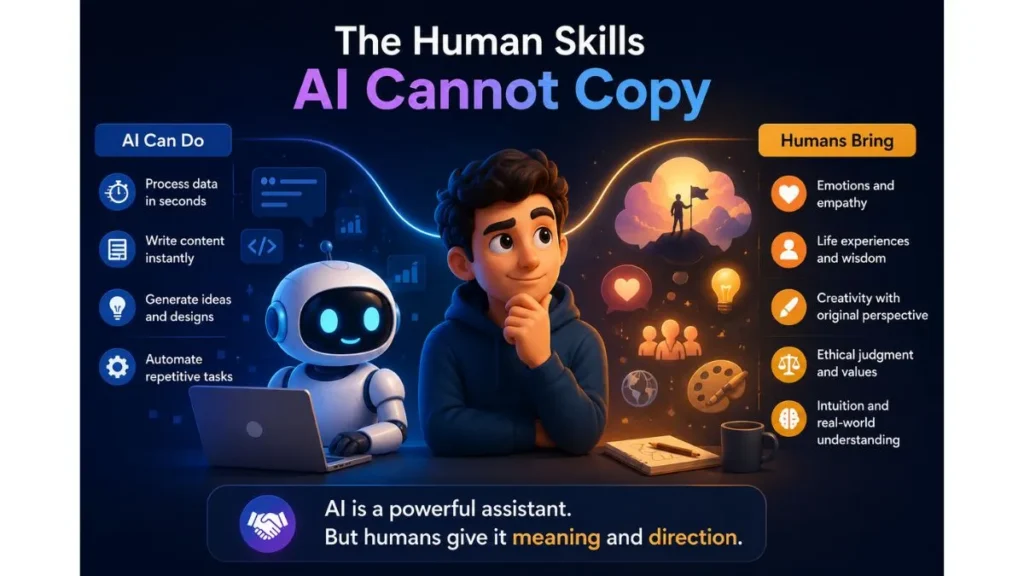
AI can generate polished output.
Humans bring personality, instincts, experiences, and real emotions behind it.
👉 AI can produce endless content
👉 Humans create things people genuinely remember
AI helps the work — humans shape the result
Right now, many industries are using AI tools daily. But when you look closely, AI is mostly helping people work faster — not fully replacing the people doing the important thinking behind the work.
For example:
- AI can generate logo ideas
→ but designers still decide what actually matches the brand - AI can write code snippets
→ but developers still fix errors and build the real logic - AI can create blog drafts
→ but humans still adjust tone, meaning, and originality - AI can suggest business ideas
→ but business owners still decide what is realistic - AI can generate video edits
→ but creators still control storytelling and emotion
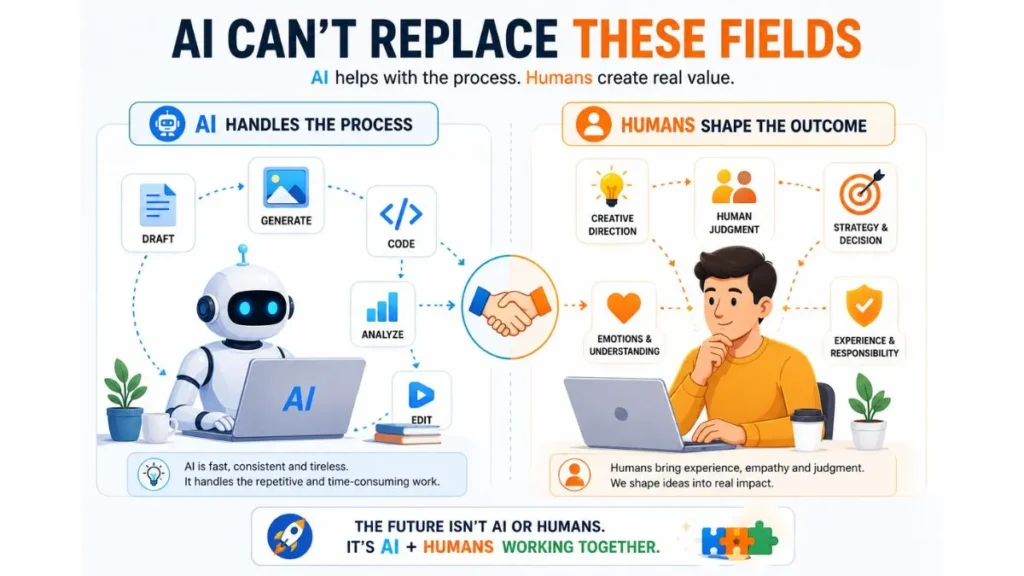
That’s why many fields are changing into something new:
Not:
❌ humans working alone
Not:
❌ AI working alone
Instead:
✅ humans working with AI
The faster AI becomes, the more important human direction starts becoming. Because tools can generate outputs — but humans still decide:
- what feels right
- what makes sense
- what people actually connect with
👉 AI speeds up execution
👉 Humans still shape the final outcome
Human creativity still feels different
AI can generate creative-looking work very quickly now. It can create:
- images
- music
- logos
- videos
- captions
- blog ideas
That’s why many people feel creativity itself is becoming automated.
But when you look closely, most AI-generated creativity still starts from existing human work, styles, and patterns already available online.
For example, AI can generate a “cinematic poster” in seconds.
But humans still decide:
- the concept
- the emotion
- the message
- the storytelling direction
- what should feel unique
The same thing happens in content creation.
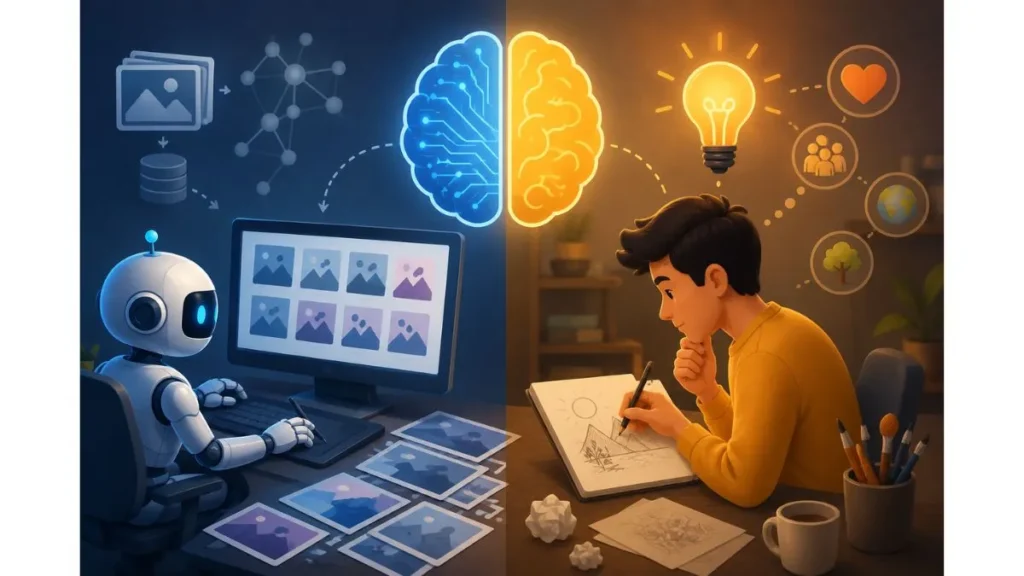
AI can help generate ideas faster, but creators still build:
- personality
- originality
- audience connection
- real experiences behind the content
That’s why many AI-generated designs or posts may look impressive initially — but after a while, they often start feeling visually similar.
Real creativity usually comes from:
- personal experiences
- imagination
- emotions
- curiosity
- unpredictable thinking
Things that don’t follow fixed patterns.
People are also starting to ask a bigger question now — if AI tools can create websites instantly, do businesses still need custom websites built by humans? That topic becomes much more interesting when you compare speed, originality, long-term branding, and real business flexibility. You can read more in our detailed guide on AI Website vs Custom Website in India: What People Don’t Realize (2026 Reality).
AI is powerful, but humans still matter
After seeing how fast AI is growing, it’s easy to feel like everything will eventually become automated. And honestly, AI is already changing the way people work, create, learn, and run businesses.
But the more people use AI daily, the more they also start noticing something important.
AI can help with speed.
AI can help with ideas.
AI can help reduce effort.
But behind most useful AI-generated work, there is still a human making decisions, correcting mistakes, adding personality, and giving direction.
That’s probably the biggest realization from this whole discussion.
The future may not be:
❌ humans replaced by AI
Instead, it may become:
✅ humans who understand how to use AI properly becoming more valuable than ever before.
Because technology keeps evolving —
but human thinking, experiences, emotions, and originality still shape what truly connects with people.
AI models are improving rapidly, but even advanced systems still depend heavily on human feedback, judgment, and supervision to improve accuracy and decision-making. Google DeepMind also explores how human guidance continues to play an important role in the development of modern AI systems. Google DeepMind AI research
FAQ
Is learning skills still worth it in the AI era?
Yes. AI tools work best when combined with strong human skills. People who understand creativity, problem-solving, communication, or strategy can often use AI more effectively than beginners.
Will AI make human skills less valuable in the future?
Some repetitive tasks may become automated, but human skills may actually become more valuable in areas where originality, communication, leadership, and decision-making matter most.
Can AI work completely on its own?
Not really. AI still depends heavily on prompts, training data, human feedback, corrections, and direction to generate useful results.
Will businesses still hire humans if AI keeps improving?
Yes, because businesses still need people for leadership, communication, branding, customer understanding, creative direction, and real-world decision making.
What type of people may benefit most from AI?
People who adapt quickly, learn continuously, and combine human thinking with AI tools will likely have the biggest advantage in the future.
My Understanding:
Right now, many people feel worried when they see how quickly AI is improving. Questions about future jobs, careers, creativity, and human value are becoming more common every day.
But AI is not only replacing work — it is also helping people work faster, learn faster, and build things more easily than before.
That’s the important part many people miss.
AI is becoming a powerful tool for people who know how to use it correctly.
Writers use AI to speed up ideas.
Designers use AI to explore concepts faster.
Developers use AI to save time while building projects.
Businesses use AI to improve productivity.
But even with all this growth, people still look for:
human creativity
original thinking
personality
trust
real experiences
emotional connection
Because technology may help generate content —
but humans still give meaning behind it.
So instead of fearing AI completely, the better approach may be learning:
👉 how to work alongside it
👉 how to use it wisely
👉 and how to improve the human skills AI still depends on
⭐ AI is becoming more powerful, but humans still decide how that power is used