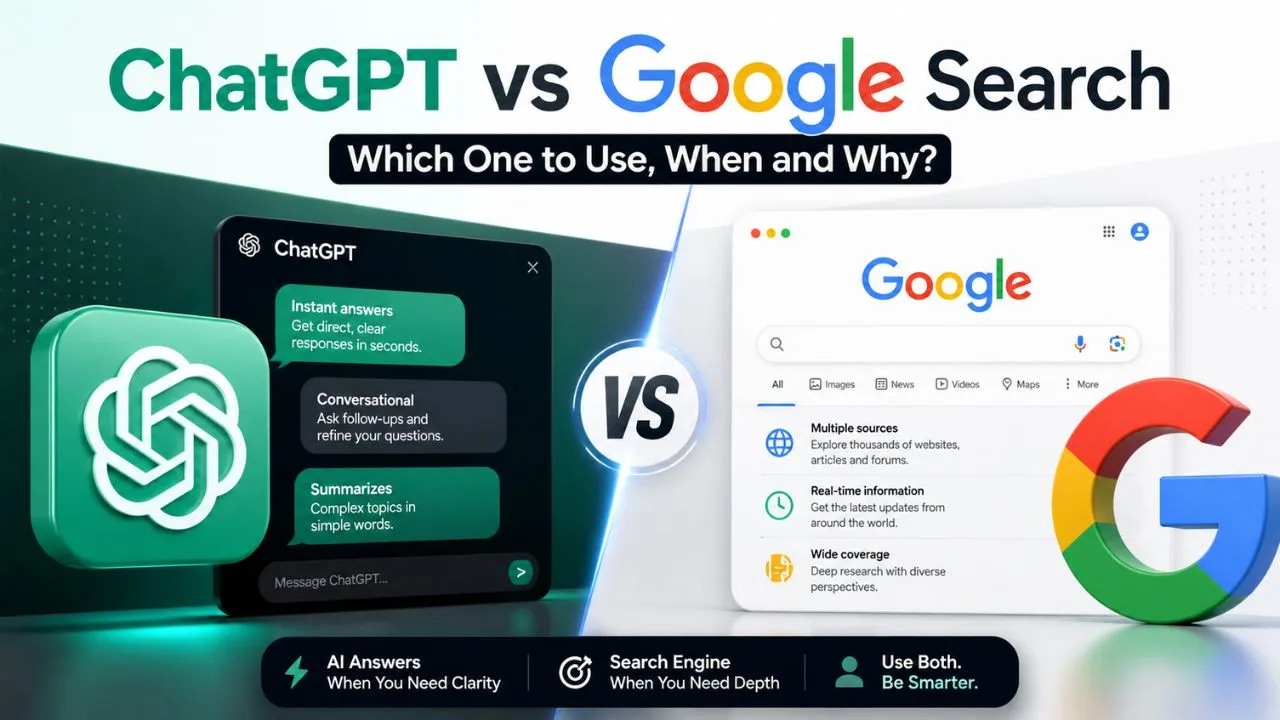
People are slowly changing the way they search for information online, and the discussion around ChatGPT vs Google Search is becoming bigger every day. Some users now prefer direct AI answers instead of browsing multiple websites, while others still trust Google for real-time updates, deeper research, and finding original sources. Both are useful, but they solve completely different problems — and that difference is becoming more noticeable in 2026.
The shift from searching to asking
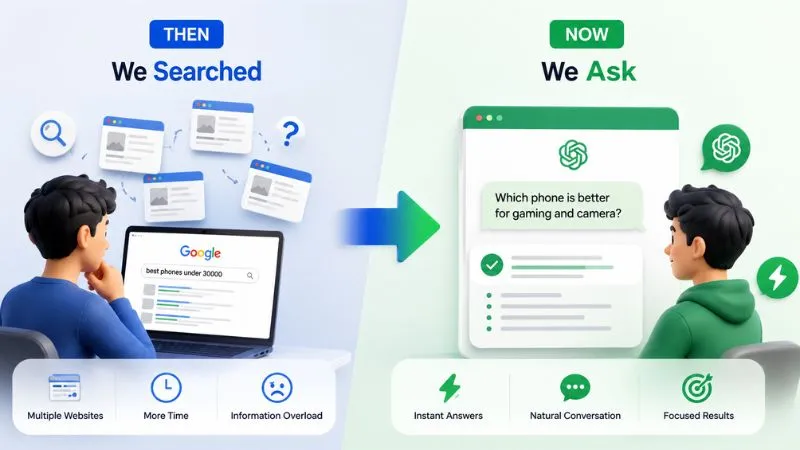
A few years ago, most people searched the internet differently.
They typed short keywords into Google like:
- “best phones under 30000”
- “SEO tips”
- “how to rank website”
Then they opened multiple websites, compared information, skipped ads, and searched again until they found a useful answer.
Now the behavior is slowly changing.
Instead of searching keywords, many people are directly asking complete questions to AI tools:
- “Which phone is better for gaming and camera?”
- “Explain SEO in simple language”
- “Help me fix my website traffic issue”
That feels faster and more natural because AI responds like a conversation instead of only showing links.
This is one of the biggest differences between ChatGPT and Google Search.
Google helps people discover information across the internet.
ChatGPT tries to directly explain the answer itself.
That’s why many users now spend less time opening multiple websites and more time interacting with AI-generated responses.
But even with this shift, people still return to Google for:
- latest news
- real-time updates
- original websites
- shopping
- maps
- videos
- source verification
Because asking AI feels convenient —
but searching the web still feels bigger and more connected to the real internet.
👉 Google changed how people search
👉 AI is now changing how people ask for answers
The future of searching online
The next big internet change may not be social media.
It may be AI becoming part of everyday search itself.
Right now, most people still open Google, type something, and browse websites manually. But in the future, searching may become much more automated and personalized.
For example, instead of searching:
- “best laptop for editing”
- “best places to visit”
- “good phone under budget”
AI systems may automatically:
- compare options
- understand preferences
- summarize reviews
- filter fake information
- give personalized recommendations instantly
That changes the internet experience completely.
Search may become:
- less manual
- less time-consuming
- more conversational
- more assistant-driven
This could heavily impact:
- bloggers
- websites
- SEO creators
- online businesses
- publishers
- even Google itself
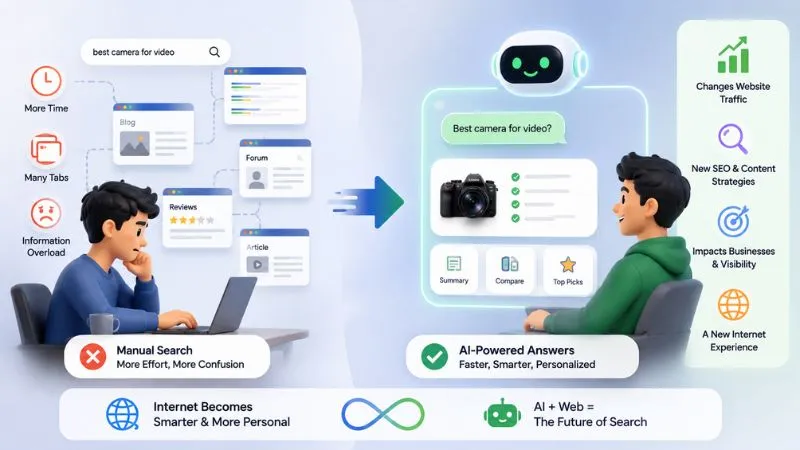
Because websites currently compete for clicks and rankings. But future AI search systems may reduce the need for users to visit multiple pages individually.
At the same time, this may also create new problems:
- fewer website visits
- AI-generated misinformation
- less visibility for small creators
- overdependence on AI summaries
So the future internet may become faster and smarter —
but also very different from the web people are used to today.
The growing popularity of AI search also connects with a bigger internet discussion happening right now — whether AI can actually replace human thinking completely. If you’re interested in the future of AI, creativity, jobs, and human skills, you can also explore our article on AI Can’t Replace Everything
AI search is changing online behavior
One strange thing happening now is this:
People are slowly becoming more comfortable talking to AI than searching the internet manually.
Earlier, if someone wanted to buy a phone, they usually:
- watched YouTube reviews
- compared websites
- read blog articles
- checked Reddit opinions
- searched multiple times on Google
Now many people simply ask AI:
“Which phone is best for gaming and camera under my budget?”
And they directly expect one simplified answer.
The same thing is happening in learning too.
Earlier:
👉 people searched different websites to understand a topic
Now:
👉 many users ask AI to explain everything in one simple response
For example:
- students ask AI for summaries instead of reading long chapters
- creators ask AI for content ideas instead of researching manually
- business owners ask AI for strategies instead of exploring multiple sources
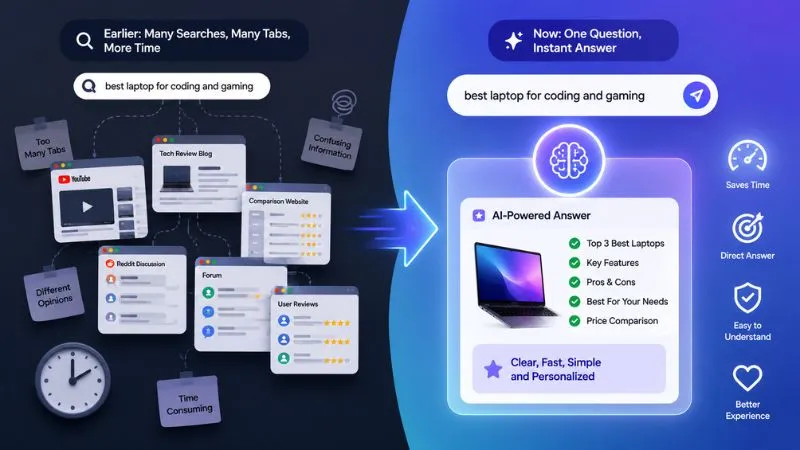
That convenience is changing online habits very quickly.
People now expect:
- less searching
- fewer clicks
- faster clarity
- simplified answers
This is why AI search feels very different from traditional internet behavior.
Earlier, the internet pushed people to explore.
Now AI increasingly pushes people toward instant answers.
That may make online life easier —
but it may also reduce curiosity, deep research, and independent thinking over time.
As AI-powered search continues growing, even companies like Google are rapidly integrating AI into their search ecosystem to change how people discover information online. Google’s official overview of AI in Search also explains how conversational AI experiences are becoming part of the future web experience. Google AI Search overview
Google still leads the internet
AI tools are becoming faster and smarter, but Google still dominates a huge part of the online world because the internet itself is much bigger than direct answers.
Most AI tools mainly focus on generating responses.
Google does something much larger:
👉 it organizes, indexes, updates, and connects the entire web continuously.
That difference matters more than people realize.
For example, imagine someone searching for:
- breaking news
- live sports scores
- trending products
- nearby businesses
- government updates
- flight information
- YouTube tutorials
- recent discussions
These things change every minute.
Google is still extremely powerful because it constantly updates information from millions of websites in real time.
AI tools usually work differently.
They often:
- summarize existing information
- simplify topics
- generate explanations
- reduce searching effort
But they may not always provide:
- latest updates
- source transparency
- live internet accuracy
- full context from multiple perspectives
Another reason Google still dominates is discovery.
Sometimes people don’t know exactly what they are searching for.
For example:
- discovering new websites
- finding creators
- exploring blogs
- comparing opinions
- researching deeply
This type of exploration is still much stronger on Google because search engines expose users to the wider internet ecosystem instead of only one generated answer.
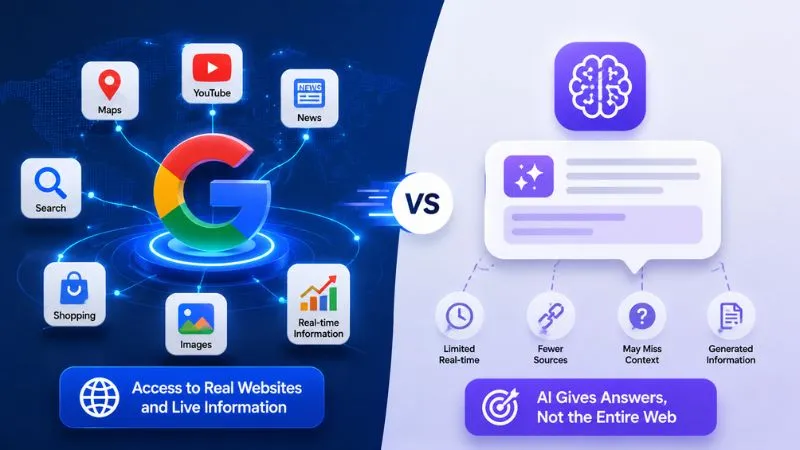
Google also powers:
- Maps
- YouTube
- Shopping
- Images
- News
- local business discovery
- website traffic itself
That means Google is not just a search engine anymore —
it has become part of how the internet functions globally.
So even though AI search feels faster and more conversational, Google still remains deeply connected to the structure of the real web.
AI search feels easier, but Google feels bigger
AI search feels similar to using a shortcut.
You enter one question.
You receive one clean response.
Everything feels controlled and simplified.
Google feels more like entering a huge digital city.
One search can suddenly lead to:
- articles
- communities
- videos
- debates
- opinions
- trending discussions
- unexpected discoveries
That creates a very different experience.
For example, imagine searching:
“Best business ideas in 2026”
AI may quickly generate:
- top ideas
- short explanations
- direct suggestions
But Google may expose you to:
- startup founders sharing experiences
- YouTube breakdowns
- Reddit discussions
- market trends
- news articles
- real business case studies
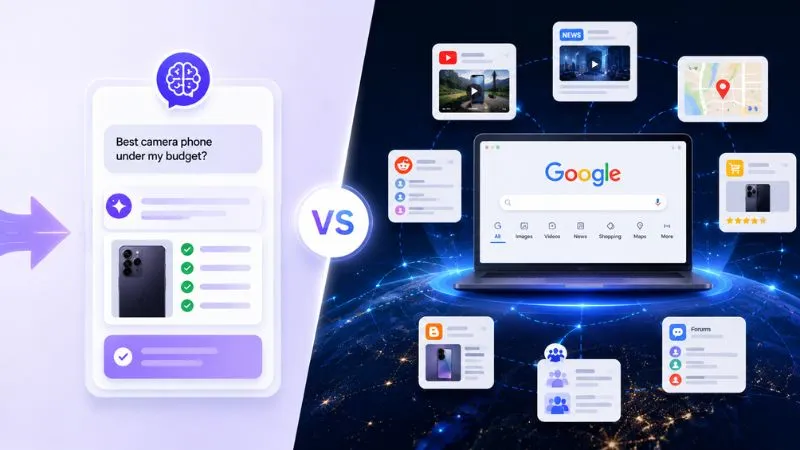
Sometimes those unexpected discoveries become more valuable than the original search itself.
That’s something AI search still doesn’t fully recreate.
AI mainly tries to reduce complexity.
Google often exposes complexity.
AI tries to protect users from information overload.
Google still throws users into the full scale of the internet.
That’s why AI feels easier for getting answers —
but Google still feels much larger, deeper, and more unpredictable.
People are also starting to compare AI search tools with other AI-powered changes happening online today. For example, many businesses now wonder whether AI-generated websites can truly compete with custom-built websites in the long run. That discussion becomes even more interesting when you look at branding, flexibility, SEO, and real business growth in our detailed guide on AI Website vs Custom Website in India: What People Don’t Realize (2026 Reality)
FAQ
Is ChatGPT replacing Google Search?
Not completely. ChatGPT is changing how people get quick answers, but Google still dominates real-time search, websites, videos, maps, shopping, and live internet discovery.
Is Google more accurate than AI search?
Google usually provides access to original sources and live information, while AI tools may sometimes generate outdated or incorrect responses depending on the topic.
Can AI search replace websites in the future?
AI may reduce some traditional searching behavior, but websites will still remain important for original content, business visibility, research, news, and real-world information.
Why does Google still feel bigger than AI tools?
Google connects users to the entire internet ecosystem including videos, blogs, communities, shopping, maps, and live updates — not only generated answers.
Which is faster for finding information?
AI tools usually feel faster for explanations and summaries, while Google is often better for deeper exploration, latest updates, and comparing multiple sources.
ChatGPT vs Google Search
Honestly, both feel powerful for completely different reasons.
ChatGPT feels better when:
- you want fast understanding
- simplified explanations
- brainstorming ideas
- quick summaries
- conversational help
Google feels better when:
- you want real-time information
- original sources
- deep research
- multiple opinions
- discovering the wider internet
That’s why this is probably not a real “winner vs loser” situation anymore.
The internet is slowly moving toward a future where:
👉 AI helps people understand faster
👉 while Google helps people explore deeper
In many situations, people may actually start using both together.
For example:
- using AI to simplify a topic first
- then using Google to explore deeper details, sources, videos, and real-world opinions
That combination already feels more natural for many users today.
So the biggest change is not:
❌ AI replacing Google completely
Instead:
✅ people are changing the way they interact with information online
And that shift may become one of the biggest internet changes of this decade.