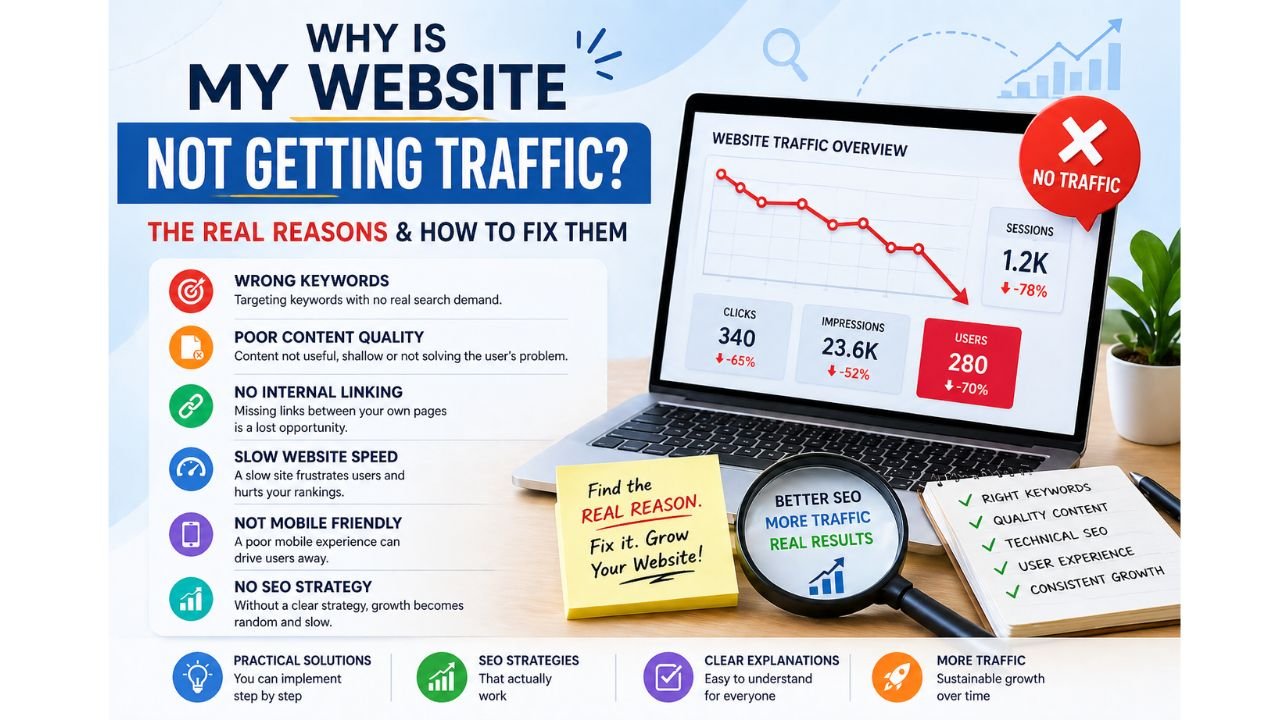
If your website is not getting traffic, you’re not alone. Many people launch a website, publish content, and expect visitors to come automatically — but nothing happens. No clicks, no impressions, and no growth. The reality is, traffic doesn’t come by luck. It comes from understanding how Google works, targeting the right keywords, and fixing the hidden mistakes that stop your website from being discovered.
👉 You’re publishing content… but no one is reading it.
👉 Your website exists… but Google is ignoring it.
Am I doing something wrong… or is there a reason my website is still not getting traffic?
👇 Let’s break down what’s actually stopping your traffic — and how to fix it step by step.
Why New Websites Don’t Get Traffic
I just created my website… so why is no one visiting?
Is it normal to have zero traffic in the beginning?
Or did I already make a mistake without realizing it?
Why This Happens
New websites don’t get traffic immediately because Google doesn’t trust them yet. Search engines need time to discover, crawl, and understand your content before showing it in search results. Without authority, backlinks, or enough content, your website stays invisible in the early stage.
How to Fix It
- Keep publishing useful content consistently
- Submit your sitemap in Google Search Console
- Focus on one niche instead of random topics
- Give it at least 4–8 weeks to gain initial traction
If my website is live… then why is it still not showing on Google at all?
To make sure your website appears on Google, you should submit it through Google Search Console and request indexing for your pages.
My Website Is Live… But Not Showing on Google?
I created my website and it’s working… so why can’t I find it on Google?
Does it take time to appear, or did I miss something important?
How long does it actually take for a website to go live on Google?
When you create a website, it becomes live on the internet immediately — but not on Google. Search engines don’t automatically show your site just because it exists. First, Google needs to discover your website, crawl your pages, and then decide whether your content is worth showing in search results.
In most cases, this process can take anywhere from a few days to a few weeks, depending on how well your website is set up and optimized.
To make your website appear on Google faster, you need to guide the process instead of waiting:
- Submit your website in Google Search Console
- Add and verify your domain properly
- Submit your sitemap so Google can find all pages
- Request indexing for important pages
- Start publishing useful content consistently
Without doing these steps, your website may stay invisible even if it’s live.
👉 Your website being live doesn’t mean Google is aware of it.
If Google hasn’t indexed my website properly… could that be the real reason I’m not getting any traffic?
What Google actually looks at
You’ve made your website live and even submitted it… but what does Google actually look at before showing it in search results?
Is it just about adding keywords… or is there something more important behind the scenes?
Google doesn’t rank your website randomly. It checks whether your site is useful, clear, and trustworthy before showing it to users. Even if your website is indexed, it won’t rank unless it meets certain basic SEO signals.
Here’s what Google mainly looks at:
- Content clarity → Does your page clearly answer a real question?
- Keyword relevance → Is your content matching what people search?
- Website structure → Is your content organized and easy to understand?
- Page experience → Is your website fast and mobile-friendly?
- Consistency → Are you regularly updating your website?
If these basics are weak, Google may index your site but won’t push it to rankings — which means no traffic.
Instead of overthinking SEO, focus on what actually matters:
- Your content clearly answers a real question
- Your topic matches what people are searching
- Your pages are simple and easy to understand
- Your website loads fast and works on mobile
- Your content is consistent, not random
When these basics are strong, Google starts trusting your website and gradually shows it in search results.
👉 Google doesn’t rank websites… it ranks useful answers.
If my content is fine… then why is my website still not getting clicks?
Everything looks fine… so why no ranking?
My website design is clean, content looks good, everything feels right…
so why is it still not ranking on Google?
This is where most people get confused.
A website can look perfect visually, but Google doesn’t rank based on design or how “good it looks.” It ranks based on how clearly your content matches a specific search intent.
If your content is too general, not focused on one clear keyword, or doesn’t directly answer a specific query, Google simply doesn’t know when to show your page.
That’s why even good-looking websites fail to rank.
To fix this, you need to shift from “good content” to targeted content:
- Focus one page = one clear keyword
- Answer one specific problem completely
- Avoid mixing multiple topics in one post
- Use simple, direct explanations instead of broad writing
When your content becomes specific and intentional, Google can understand it better — and that’s when ranking starts.
👉 A clean website doesn’t guarantee ranking — clarity does.
You can check your website speed and performance using Google Page Speed Insights and fix issues that may be affecting your rankings.
Maybe I’m targeting the wrong keywords?
I’m writing content… but how do I know if people are even searching for it?
Am I choosing topics randomly without realizing it?
Here’s the truth most beginners miss:
Your content doesn’t rank because it’s “good” — it ranks because it matches what people are actually searching for.
That’s where keywords come in.
If your topic is too broad like:
- “SEO tips”
- “make money online”
👉 You’re competing with huge websites — almost impossible to rank.
But when you go specific, like:
- “why my website is not getting traffic”
- “how to get traffic without ads for new website”
👉 Now Google understands exactly when to show your content.
Think of keywords like this:
- Broad keywords → High competition, low chance
- Specific (long-tail) keywords → Lower competition, higher ranking chance
And Google prefers content that:
- Focuses on one clear keyword
- Solves one specific problem
- Matches search intent exactly
Instead of guessing topics, start thinking like a user:
👉 “What would I search if I had this problem?”
That’s your keyword.
👉 Ranking is not about writing more — it’s about writing what people are already searching.
I’m using the right keywords… so why no traffic?
I chose topics people are actually searching for…
I followed proper SEO structure…
Still, my website is not getting traffic — what’s missing?
This is where most people hit a wall.
Even if your keywords are correct and your topic has search demand, Google still doesn’t rank your content automatically. Because ranking is not just about what you write — it’s about how your content performs compared to others already ranking.
Let’s break this down clearly:
Same keyword… different outcomes
Example keyword:
👉 “website not getting traffic”
Now imagine:
Page A (yours):
- Basic explanation
- Few points
- No real depth
- No examples
Page B (competitor):
- Covers multiple reasons clearly
- Gives real fixes step by step
- Structured properly (headings, flow)
- Keeps users engaged longer
👉 Google will always prefer Page B
Not because your content is wrong —
but because the other content is more helpful and complete.
What Google actually measures
Even if you don’t see it directly, Google tracks:
- Do people stay on your page or leave quickly?
- Does your content fully answer the query?
- Is your page more useful than others?
- Is your website building consistency over time?
If your content is “okay” and others are “better” —
you won’t rank.
What you need to change
To move from not ranking → ranking, focus on:
- Going deeper, not just writing basics
- Explaining clearly, not generally
- Structuring content for easy reading
- Covering the topic completely (no gaps)
- Improving existing posts, not just adding new ones
👉 Traffic doesn’t come to websites that exist — it comes to websites that solve better than others.
If you’re wondering why some websites grow while others struggle, this detailed breakdown explains it clearly → Why Some Websites Make Money… And Most Don’t
Did I miss any SEO basics?
I’ve written the content, chosen the keyword… but did I miss something important?
Is there a simple checklist I should follow before expecting rankings?
Before expecting traffic, every blog post should pass a basic SEO check. Even small mistakes can stop your content from ranking, no matter how good it is.
Here’s a simple checklist to confirm your post is actually optimized:
- Your main keyword is clearly used in the title and first paragraph
- The content focuses on one specific topic, not multiple ideas
- Headings are structured properly (H1 → H2 → H3 flow)
- Your content is easy to read (short paragraphs, simple language)
- Internal links are added to related posts
- Meta title and description are written properly
- Images are optimized with relevant alt text
- The page loads fast and works well on mobile
If even 2–3 of these are missing, your chances of ranking drop significantly.
Instead of publishing and moving on, take a few minutes to review your content with this checklist. Small improvements often make a big difference in visibility.
👉 SEO is not complicated — but missing the basics can cost you rankings.
If everything is optimized… then is consistency the final key to getting traffic?
If your website is not getting traffic, it’s not because nothing works — it’s because something is missing in the chain.
Fix your basics, choose the right keywords, improve your content depth, and stay consistent.
That’s how websites grow — not instantly, but steadily.
The type of website you build also affects long-term performance. Here’s a clear comparison to understand what actually works → AI Website vs Custom Website in India: What People Don’t Realize (2026 Reality)
How long does it actually take to rank?
I’ve created useful content… so how long should it take to rank on Google?
Is it supposed to happen in days… or does it take months?
Or am I expecting results too early?
Ranking doesn’t happen instantly — even if your content is good.
For a new website, Google usually takes time to understand your content, test it, and decide where it fits in search results. In most cases:
- New websites may take 4 to 12 weeks to see initial movement
- Some pages rank faster, but most take consistent effort
- Competitive topics can take months, not days
Google doesn’t work on time — it works on trust and consistency.
Even useful content won’t rank quickly if:
- Your website is new
- You don’t have enough content depth
- There’s no authority or backlinks yet
What actually helps is:
- Publishing consistently (not one-time effort)
- Sticking to one clear niche
- Improving content over time instead of leaving it static
Ranking is not about “how fast” — it’s about how clear and consistent your website is over time.
👉 Good content doesn’t rank instantly — it earns its position gradually.
FAQ
How do I know if my website is actually indexed on Google?
You can check this by searching:
👉 site:yourdomain.com
If your pages appear, your website is indexed. If not, you need to submit your site in Google Search Console and request indexing.
Can I get traffic without doing SEO?
Yes, but not from Google. You can get traffic from social media or direct sharing. However, for consistent and long-term traffic, SEO is necessary.
Can I rank my website without technical SEO knowledge?
Yes. You don’t need advanced technical skills to start. Basic SEO practices like good content, keyword targeting, and proper structure are enough in the early s
Does website design affect SEO ranking?
Design itself doesn’t directly impact rankings, but a clean, fast, and mobile-friendly design improves user experience — which indirectly helps SEO.
How many blog posts do I need before I start getting traffic?
There is no fixed number, but most websites start seeing results after publishing 10–20 focused, high-quality posts consistently.
What I learned from building my own website
When I first started badridigitaltech.com, I thought creating a clean website and writing content would be enough to get traffic.
But that wasn’t the reality.
In the beginning, my website looked good — proper design, structured pages, and decent content. Still, there was no traffic. That’s when I realized SEO is not about just building a website… it’s about understanding how search actually works.
I started improving step by step:
- Focused on writing content based on real search problems
- Stopped creating random posts and chose clear topics
- Improved content structure to make it easier to read
- Connected posts through internal linking
- Learned how Google understands keywords and intent
Instead of trying everything at once, I focused on fixing one thing at a time — and that’s what started making a difference.
Over time, I understood something important:
👉 SEO is not a shortcut — it’s a skill you build by testing, learning, and improving.
If you’re starting out, don’t try to master everything at once. Start by understanding how content works, how keywords connect to search, and how consistency builds trust.