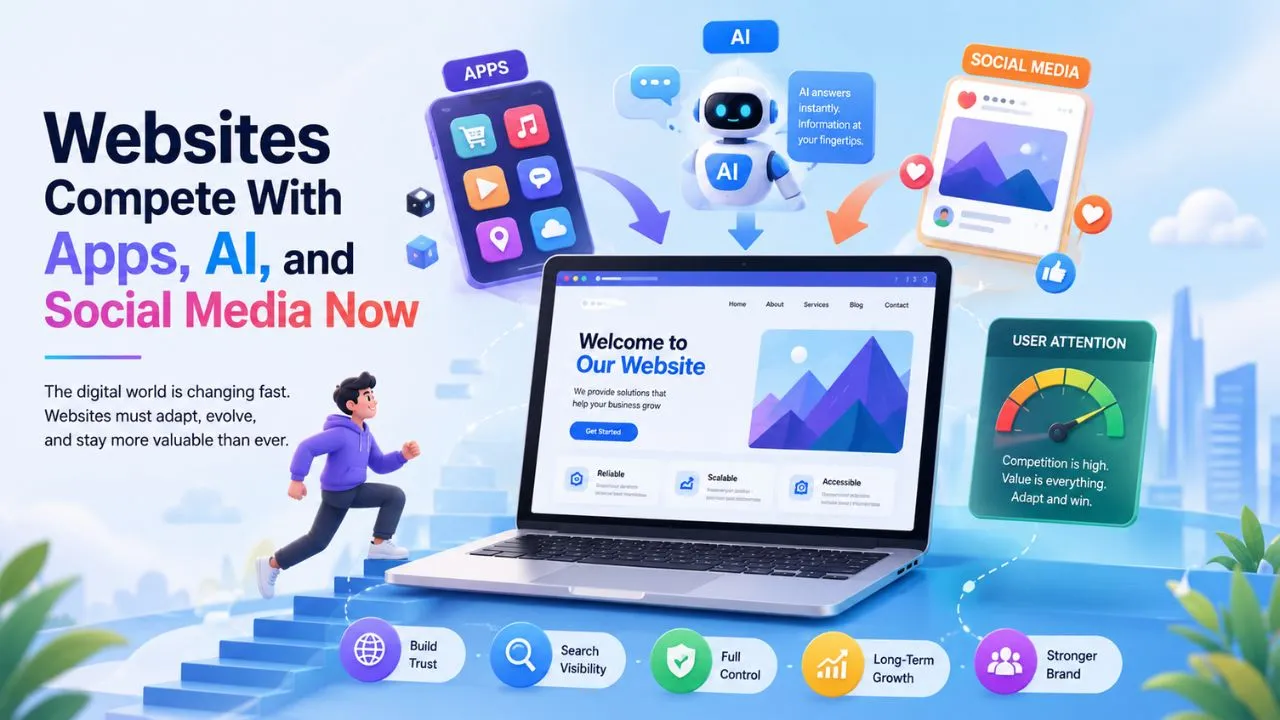
The internet no longer works the same way it did a few years ago. Today, websites compete with apps and AI for user attention as people spend more time on social media feeds, short videos, AI tools, and mobile platforms instead of browsing traditional websites deeply. Online behavior is becoming faster, more algorithm-driven, and heavily platform-based, which is changing how businesses, creators, and websites attract traffic and stay visible online.
Why websites still matter today
One big misunderstanding today is this:
Many people think social media pages, apps, or AI visibility can completely replace websites in the future.
But when something becomes truly important online, people still look for the official website.
For example, someone may first discover:
- a business from Instagram
- a creator from YouTube
- a product from TikTok
- information from AI tools
but later they often search:
👉 “official website”
without even thinking about it.
Because websites still feel like the most stable and complete place for real information online.
Social media feels temporary.
Apps feel controlled by platforms.
AI gives summaries.
But websites still feel like the actual “source.”
This becomes even more important in the future because internet platforms change constantly.
Algorithms change.
Apps rise and disappear.
AI systems evolve rapidly.
But websites still remain one of the few long-term digital assets businesses fully control themselves.
That’s why many serious businesses still invest heavily in websites even while growing on:
- YouTube
- AI platforms
- social apps
Because platforms help businesses get attention.
Websites help businesses build stability.
In the future, websites may stop being the “center” of internet attention —
but they will likely remain one of the most trusted foundations of online identity.
Apps and AI Changed User Behavior Online
A few years ago, using the internet usually meant opening websites.
People searched on Google, opened blogs, explored forums, visited company websites, and spent more time browsing different pages manually.
Now internet behavior feels completely different.
Today, many users spend most of their online time inside:
- YouTube
- TikTok
- AI tools
- shopping apps
- messaging platforms
without visiting traditional websites very often.
For example, earlier if someone wanted:
- restaurant reviews
- travel ideas
- tech information
- product recommendations
they usually searched Google and explored websites.
Now many people:
- watch short videos
- ask AI directly
- check Instagram reels
- search inside apps
- follow creator recommendations
instead of browsing websites deeply.
Even shopping behavior changed.
Earlier:
👉 users explored many websites before buying
Now:
👉 many users directly open Amazon, YouTube, Instagram, or AI tools first.
This is creating a completely different internet ecosystem.
Apps are becoming “closed environments” where users spend hours without leaving the platform. AI tools are also reducing the need to manually search multiple websites for simple information.
That means websites are no longer competing only with other websites anymore.
Now they compete against:
- short videos
- algorithms
- notifications
- AI conversations
- social feeds
- entertainment apps
all at the same time.
👉 Earlier, websites were the center of the internet
👉 Now attention is spread across platforms, apps, and AI systems everywhere.
Traditional browsing is slowly changing
One interesting thing happening on the internet now is this:
People no longer “travel” through websites the way they used to.
Earlier, users often opened many tabs and explored the web step by step. The internet experience felt slower, deeper, and more connected to websites themselves.
Today, the experience feels more compressed.
Many users now consume internet content in small pieces:
- one reel
- one AI answer
- one short video
- one notification
- one app recommendation
and then quickly move somewhere else.
The internet is starting to behave more like a stream of content instead of a collection of websites.
For example, someone may:
- discover a product from Instagram
- learn something from YouTube Shorts
- ask AI for quick information
- buy directly from an app
without ever browsing multiple websites deeply.
Even younger internet users are becoming more familiar with:
- scrolling
- swiping
- watching
- tapping
than traditional website exploration.
This is slowly changing the meaning of “browsing the web.”
Users scroll more than they browse
Modern internet users rarely move through the web slowly anymore.
Instead of sitting and exploring websites carefully, most people now move through content very fast without even realizing it.
For example, someone may:
- open Instagram for 2 minutes
- watch 20 reels
- check YouTube Shorts
- reply to messages
- open an AI app
- search something quickly
- jump back to another platform
all within a very short time.
This creates a very different online mindset.
People are becoming more used to:
- instant stimulation
- endless scrolling
- fast recommendations
- short bursts of information
instead of long browsing sessions.
Even when users open websites now, many still behave with that same scrolling mindset.
They quickly:
- scan headlines
- swipe past sections
- look for fast answers
- judge pages instantly
- move on quickly if attention drops
For example, many users no longer search:
“best smartphones detailed review”
and spend 20 minutes reading websites carefully.
Instead they may:
- watch a 30-second comparison reel
- ask AI for a quick summary
- check comments
- see creator opinions
- decide quickly
This is changing how internet attention works.
Websites Still Matter Beyond Social Media
Social media platforms are built for fast visibility and constant scrolling. Content appears quickly, disappears quickly, and competes with thousands of other posts at the same time.
Websites work differently because they allow businesses and creators to organize everything properly in one connected place instead of depending only on short-form content.
Discover how websites and social platforms play different roles in business growth in Website vs Social Media in India: What Actually Works for Business Growth?
Websites Keep Content Alive Longer
Most social media content survives only for a short time before new trends replace it. But websites can continue bringing visitors through:
- Google search
- direct visits
- backlinks
- old blog posts
- searchable pages
even long after the content was originally published.
Websites Build a Bigger Digital Presence
A social media page usually shows small pieces of content, while a website can build a complete online presence around a business or brand.
Websites can combine:
- products
- services
- blogs
- portfolios
- support pages
- SEO traffic
- business information
inside one system that continues growing over time.
Websites Are Still Important in the AI Era
AI tools are changing how people search, learn, and consume information online. Many users now ask AI directly instead of opening multiple websites manually like before.
But even with this shift, websites still continue playing a major role across the internet.
AI Still Depends on Website Information
Most AI systems learn from large amounts of online content that already exists across the web. Much of that information originally comes from:
- websites
- blogs
- forums
- documentation
- articles
- business pages
Without websites constantly publishing information, the internet would become much smaller and less useful for AI systems over time.
For example, when users ask AI about:
- products
- businesses
- tutorials
- services
- technical information
the original source often still begins somewhere on the web itself.
Websites Still Handle Real Business Activity
AI tools can summarize information quickly, but websites still continue handling many important parts of the internet experience.
For example, businesses still use websites for:
- service pages
- customer support
- payments
- bookings
- portfolios
- dashboards
- account systems
- documentation
- SEO traffic
AI may help users discover information faster, but websites still power many actual online operations behind the scenes.
AI Gives Answers — Websites Give Full Context
AI usually provides compressed answers designed for speed and convenience. But websites still remain important when users want:
- detailed explanations
- official information
- comparisons
- long-form content
- complete guides
- deeper exploration
For example, someone may ask AI:
“Which laptop is best for video editing?”
But later they may still open websites to:
- compare specifications
- watch reviews
- read detailed benchmarks
- check pricing
- explore multiple options carefully
That’s why websites are still likely to remain an important part of the internet even as AI changes online behavior rapidly.
Explore why human skills still matter in the modern AI era in our detailed post on AI Can’t Replace Everything.
Websites Still Matter More Than People Think
A lot of modern internet discussion now focuses on:
- AI tools
- social media platforms
- apps
- short videos
so websites sometimes feel less visible compared to earlier internet years.
But something important is happening quietly in the background:
The internet still keeps returning to websites whenever information needs to become more permanent, structured, searchable, or scalable.
For example, short-form content works well for:
- quick discovery
- fast reactions
- temporary trends
- entertainment
But websites are still where businesses usually build things that need to last longer.
That includes:
- knowledge bases
- business ecosystems
- searchable content
- customer systems
- documentation
- service structures
- long-form publishing
- product architecture
This becomes even more important as internet content grows faster every year.
AI-generated content, endless feeds, short videos, and algorithm-driven platforms are increasing the speed of online consumption dramatically. Because of that, websites are slowly becoming one of the few places where information can still stay organized and connected properly over time.
Another reason websites still matter is because they work across the open internet itself.
A website can:
- appear in search engines
- connect through links
- integrate with apps
- support AI systems
- work across devices
- remain accessible independently
without being fully locked inside one platform ecosystem.
That flexibility is one reason websites still continue evolving instead of disappearing.
The modern internet may no longer revolve around websites the same way it once did, but websites still remain one of the strongest foundations underneath the digital world itself.
The Internet Changed — But Websites Still Matter
It feels like the whole internet is just three or four apps now. If everyone is just scrolling their feeds, why do you still need a website?
Here is the simplest way to look at it:
Social media is a crowded party. A website is your quiet office.
Here is why you still need your own space:
No Distractions:
On an app, your work is sandwiched between a funny meme and a loud ad. People are easily distracted.
On your website, there is no background noise. You have their 100% focus.
You Make the Rules:
Apps control who sees your stuff. They can hide your posts, change the layout, or delete your account for no reason.
On your website, you are the boss. Nobody can kick you out.
Boredom vs. Action:
People scroll apps when they are bored.
People visit websites when they actually want to do something—like click an affiliate deal, read a portfolio, or hire a designer.
Nothing Gets Lost:
A post on an app is old news by tomorrow. If a user wants to find a link you posted last week, it is gone.
On a website, your best stuff is always right there on the menu.
Escape the “Content Treadmill”:
On apps, you have to post every single day just to stay visible. If you take a week off, the algorithm forgets you exist.
A website works for you while you sleep. A good page or article can bring in free traffic from Google for years without you lifting a finger.
Links That Actually Work:
Apps want to keep users trapped inside their walls. They make links unclickable in captions, or force you to hide everything in a single “link in bio.” On your website, you have total freedom. You can put a big, clean, clickable button exactly where you want it.
As mobile apps, AI tools, and social platforms continue changing online behavior, even Google has discussed how modern web experiences are evolving across devices, search, and digital ecosystems. You can explore more through Google Search Central.
FAQ
Is social media replacing websites completely?
No. Social media changed how people discover content, but websites still remain important for business infrastructure, searchable information, products, and long-term online presence.
Can AI reduce website traffic in the future?
AI tools may reduce some traditional browsing behavior for quick answers, but websites will still remain important for deeper information, services, transactions, and original web content.
Do AI tools depend on websites?
Yes. Much of the information AI systems summarize originally comes from websites, blogs, forums, documentation pages, and other web-based content.
Will apps replace websites completely?
No. Apps may dominate daily attention, but websites still continue supporting many online activities including services, accounts, payments, dashboards, and business operations.
Why are websites still part of the future internet?
Because websites continue evolving alongside AI, apps, cloud systems, and digital platforms instead of becoming outdated or disappearing completely.
⭐ The internet is moving faster than ever. Apps change overnight, AI is rewriting how we find information, and social trends come and go. But through all the noise, a website remains the only piece of the digital world that you actually own. It is your anchor. Don’t build your entire future on platforms where someone else controls the rules.
🤘 Apps give you fleeting views, AI gives people quick answers, but your website is the only thing that gives you total control.